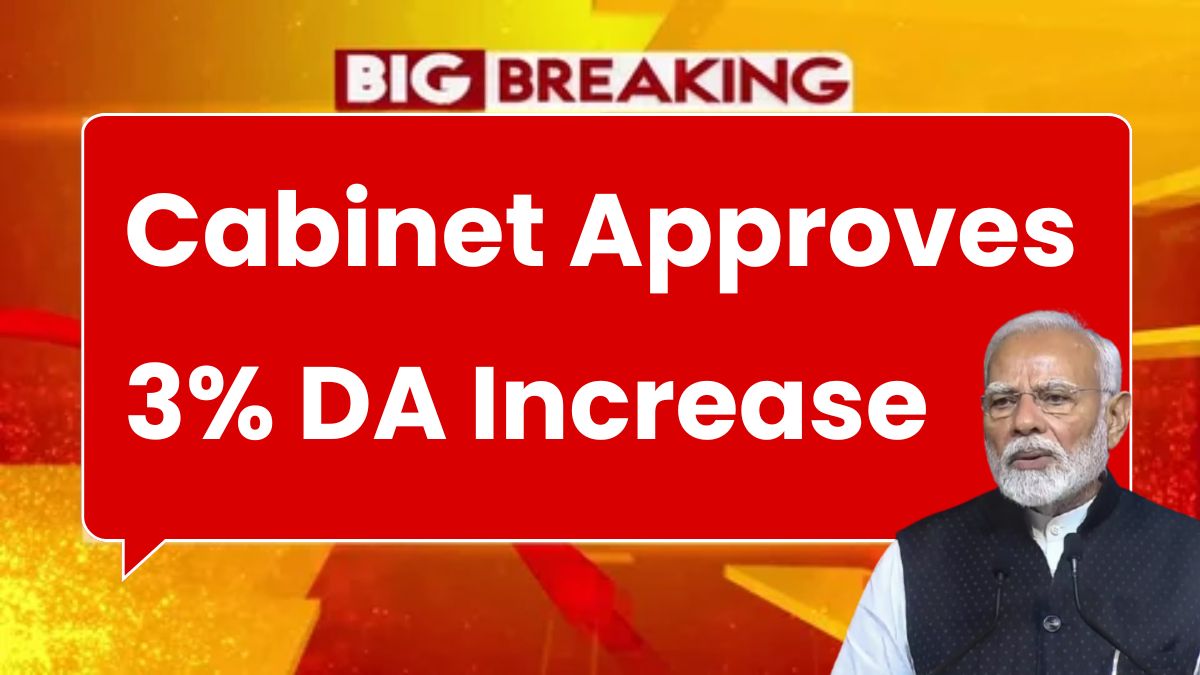
Cabinet Approves 3% DA Increase – The Union Cabinet has rolled out a series of landmark decisions spanning public sector welfare, agricultural development, education infrastructure, and regional connectivity. Among the highlights is a dearness allowance revision for central government staff and retirees, set to take effect in mid-2025.
Government Workers and Pensioners to Receive Higher Monthly Pay
Over 1.18 crore individuals — including roughly 49 lakh active employees and nearly 69 lakh retired pensioners — are set to benefit from a 3 percentage point rise in Dearness Allowance (DA) and Dearness Relief (DR). The revised rates will come into force starting July 1, 2025.
DA adjustments are carried out twice annually by the government and are pegged to fluctuations in the Consumer Price Index, which tracks the cost of everyday goods and services. The latest revision acknowledges the sustained inflationary pressure households have been facing in recent months, particularly in the context of climbing prices for essential commodities.

For employees across various pay grades, the hike translates into a tangible increase in monthly take-home pay. Pensioners, meanwhile, will find it easier to meet daily expenses such as healthcare and household bills. With conversations around the proposed 8th Pay Commission picking up pace ahead of 2026, this DA update is widely seen as a precursor to broader salary reforms on the horizon.
57 New Kendriya Vidyalayas to Strengthen School Education
In a significant move for the education sector, the Cabinet has sanctioned the construction of 57 new Kendriya Vidyalayas at a combined cost of ₹5,862 crore. The expansion is strategically designed to reach areas that currently lack access to quality schooling, including aspirational districts, regions affected by left-wing extremism, hilly terrains, and the northeastern states.
Of the new schools, 20 will be established in districts that do not yet have a Kendriya Vidyalaya, while 14 will be located in districts designated for focused developmental attention. Collectively, these institutions are expected to accommodate around 87,000 students and generate approximately 4,600 jobs for teachers and support staff.
यह भी पढ़े:
 Unified Pension Scheme 2026: Want a Secure Monthly Income After Retirement? Here’s How It Works
This expansion reflects the government’s intent to make quality, standardised education accessible beyond urban centers, contributing to greater educational equity across the country.
Aatmanirbhar Pulses Mission to Cut Import Dependence
The Cabinet also greenlit a dedicated mission aimed at achieving self-reliance in pulse production. Backed by an outlay of ₹11,440 crore and spanning the years 2025–26 through 2030–31, the initiative targets raising domestic pulse output to 350 lakh tonnes — a goal that would substantially reduce the country’s reliance on imported lentils and legumes.
Around 2 crore farmers are expected to be covered under the scheme, which offers support in the form of improved seed varieties, post-harvest infrastructure, and climate-resilient crop technologies. Enhanced productivity not only means better earnings for farmers but also contributes to national food security by ensuring a steady domestic supply to meet growing consumer demand.

MSP Revisions Offer Better Returns for Rabi Crop Growers
Farmers cultivating Rabi crops will also gain from revised Minimum Support Prices for the 2026–27 marketing season. Safflower growers stand to gain the most, with the support price increased by ₹600 per quintal. Masur (lentil) farmers will receive an additional ₹300 per quintal, providing stronger price assurance during harvest.
These revisions are designed to shield cultivators from erratic market conditions and to ensure that the cost of farming inputs does not outpace the revenue earned from crop sales. Higher MSPs underpin the government’s broader commitment to rural economic stability and sustainable farming practices.
Four-Lane Highway in Assam to Spur Northeast Development
Rounding out the Cabinet’s agenda was approval for a major road infrastructure project in Assam. The Kalibor–Numaligarh segment of National Highway-715, stretching approximately 85 kilometres, will be widened into a four-lane corridor at an investment of ₹6,957 crore. The project will be executed under the Engineering, Procurement and Construction (EPC) model.

The upgraded highway is expected to significantly cut travel time, improve road safety, and facilitate the movement of goods and people across the northeastern region. Given Assam’s position as a gateway to several border states, better road connectivity carries strategic importance beyond mere commuter convenience — it supports trade expansion, encourages tourism, and improves access to essential services for communities in remote areas.
Taken together, these Cabinet approvals represent a multi-pronged push to address the immediate needs of government employees and farmers while laying the groundwork for long-term gains in education, food security, and regional infrastructure.