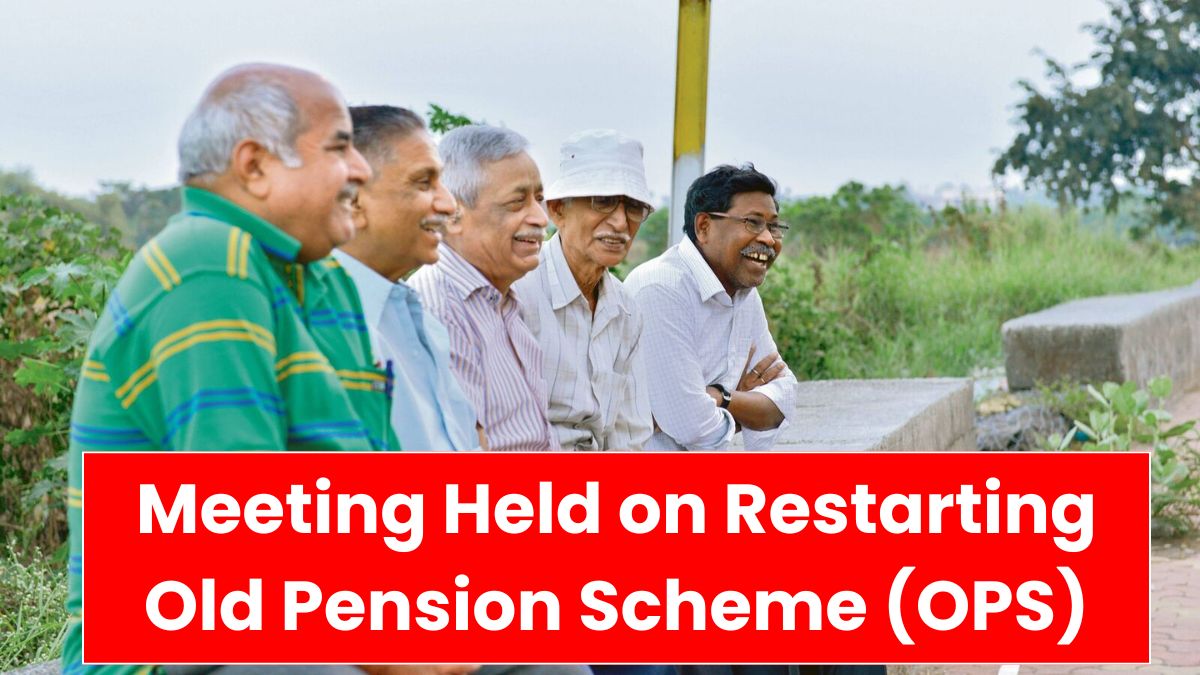
Old Pension Scheme – Across India, a topic has once again taken center stage that directly touches the lives of millions of central government employees — the possible return of the Old Pension Scheme, commonly known as OPS. Recent reports suggest that the Union Government has convened high-level cabinet discussions on this very issue, sparking a renewed sense of optimism among government workers nationwide. According to sources, senior bureaucrats and policy experts have been asked to examine the feasibility and practicality of reintroducing the old pension framework. For countless employees who have long struggled with the uncertainties built into the current pension system, this development feels like the first real glimmer of hope in years.
What Exactly Was the Old Pension Scheme?
The Old Pension Scheme was a defined-benefit retirement system under which a government employee, upon completing their service, was entitled to receive a fixed monthly pension amounting to roughly half of their last drawn basic salary — for the rest of their life. What made this arrangement particularly attractive was that the entire financial burden rested squarely on the government’s shoulders, with no contribution whatsoever deducted from the employee’s monthly salary. Additionally, the scheme included a family pension provision, which ensured that in the event of an employee’s death, their surviving spouse and dependent children would continue to receive financial support. It is precisely this promise of a guaranteed, lifelong income that has made OPS so deeply cherished — and so passionately demanded — by government workers across the country.
Why Are Employees Deeply Dissatisfied with the Current System?
In 2004, the central government replaced OPS with the National Pension System, widely referred to as NPS, which operates on an entirely different philosophy. Under NPS, both the employee and the government contribute a portion of the salary into a pension fund, and the amount received after retirement depends entirely on how well the financial markets have performed over the years. This reliance on market performance is the core of employees’ anxiety — since no one can predict with certainty what the stock market will look like at the time of retirement, the actual pension amount remains unknown until the very end. Unlike OPS, NPS offers no fixed income guarantee post-retirement, leaving employees feeling financially vulnerable and emotionally unsettled about their future.

Some States Have Already Led the Way
This demand for OPS restoration is no longer just a rallying cry — it has already been translated into policy action by certain state governments. States like Rajasthan and Chhattisgarh took the bold step of reinstating the Old Pension Scheme for their own state government employees, a decision that sent ripples of encouragement across the entire country. These examples have proven, in practical terms, that bringing back OPS is not an impossible task — it can be done and it has been done. These state-level initiatives have simultaneously emboldened employees in other parts of the country and increased pressure on the central government to take a similarly decisive step for its own workforce.
The Financial Hurdle the Government Must Clear
Despite the emotional and political appeal of OPS restoration, the biggest obstacle standing in the way remains an economic one. Financial experts and economists have consistently pointed out that reintroducing the Old Pension Scheme would place a substantial and long-term burden on the national treasury, since the government alone would bear full responsibility for paying pensions to a large retiring workforce over several decades. This is precisely why the Finance Ministry’s input in the current cabinet deliberations is being treated as particularly critical — any decision of this magnitude must be preceded by a thorough and honest assessment of the country’s fiscal health and long-term financial sustainability. That said, the political dimension of this issue cannot be ignored either; the loyalty and support of crores of government employees and their families can significantly influence electoral outcomes, making this a matter of both economic and political consequence.
Employees’ Unions Speak in One Voice
Employee associations and trade unions from every corner of India have been relentlessly advocating for the restoration of OPS, and their message has remained consistent — this is not merely a financial demand, but a matter of basic social security and human dignity. Their argument is both simple and compelling: those who dedicate their most productive years to serving the nation deserve the assurance that their old age will be financially secure and dignified. Several major employee organizations have directly appealed to the government, urging it to prioritize employee welfare and restore OPS without further delay.
यह भी पढ़े:
 Unified Pension Scheme 2026: Want a Secure Monthly Income After Retirement? Here’s How It Works
What Lies Ahead — and What Should Employees Do?
As things stand, the central government has not yet made any formal announcement regarding the restoration of OPS. However, the fact that the matter is receiving serious attention at the cabinet level is itself a positive development. In the days to come, a significant and potentially life-altering decision could emerge that shapes the retirement futures of millions of Indian families. In the meantime, all government employees are strongly advised to rely only on official communications from government bodies — such as the Department of Personnel and Training or the Ministry of Finance — and to avoid being misled by unverified social media posts or circulating rumors.